
If you’re planning a training camp on the Costa Blanca, competing regularly, or simply want to train more (and better) without piling up injuries, there’s one thing that many athletes overlook: performance doesn’t come only from hard training — it comes from quality recovery.
At Kenkatsu Benidorm, we approach sports recovery in Benidorm as a system: therapy, technology, planning and real rest. In this guide, you’ll learn what “sports recovery” actually means and how to apply it so your body adapts to training, reduces overload risk, and shows up strong for the next block.
Want a ready-to-book pack (1–2 pax)? Explore our experiences in the experiences and choose what fits your goal (performance, getting in shape, or recovery).
Recommended experiences (1–2 pax)
Depending on your trip and your level, these experiences are designed to combine training, rest and recovery:
- High-Performance Sports Experience (Standard)
- High-Performance Sports Experience (Premium)
- Get in Shape Experience (Standard)
- Get in Shape Experience (Premium)
- Physiotherapy & Recovery Experience (Standard)
- Physiotherapy & Recovery Experience (Premium)
What sports recovery is (and what it is NOT)
Sports recovery is the set of strategies that help your body:
- repair tissue (muscle, tendon, joints) after training stress
- restore energy and nervous system balance
- reduce accumulated fatigue to sustain volume and intensity over weeks
- stay consistent (the real “secret” behind progress)
It’s not “getting a massage only when you’re broken”. Recovery works when it’s built into the plan — just like intervals or gym work.
The Kenkatsu method: 4 pillars to recover and perform
1) Therapy and sports physiotherapy
Sports physiotherapy isn’t just “pain treatment”: it’s about optimising mobility, unloading overworked areas, and correcting patterns that can become injuries under fatigue.
In a training camp, therapy helps you:
- keep volume without flare-ups
- arrive fresher to key sessions
- improve range and efficiency (running economy / cycling mechanics)
Learn more about physiotherapy.
2) Recovery technology (oxygen, pressure, cold, etc.)
Technology doesn’t replace the basics (train, eat, sleep), but it can improve sensations and speed up recovery at the right moments (high-load blocks, double sessions, travel, etc.).
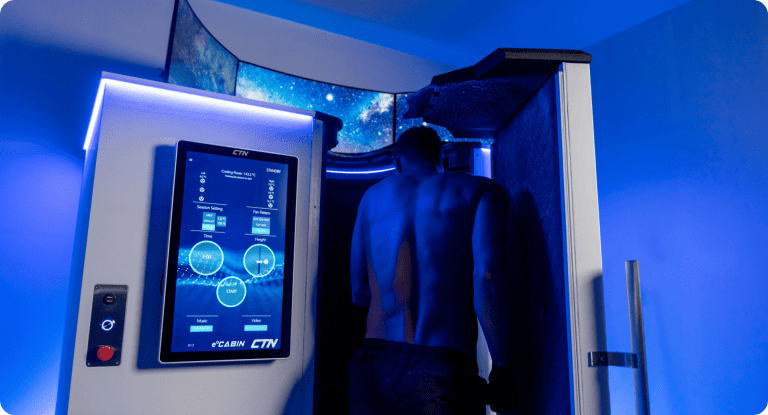
Depending on the case, it may make sense to combine cryotherapy, oxygen therapy and a recovery circuit.
3) Hypoxia training (when it makes sense)
Well-planned hypoxia can be a useful tool for endurance athletes, especially when:
- you’re building base fitness and load tolerance
- you want a strong stimulus with less mechanical impact
- you’re sharpening for competitions where intensity control matters
4) Rest and environment (the silent multiplier)
Recovery can’t be “purchased” with a treatment if the foundations aren’t there:
- sleep
- hydration and nutrition
- stress management
- routine and real downtime
That’s why a place designed for quality rest (and a frictionless routine) changes the outcome of any camp.
Who this is for (teams and individuals)
This approach is especially useful if you’re:
- a cyclist (accumulated fatigue + neck/lower-back overload)
- a triathlete (double/triple sessions + fast turnaround recovery needs)
- a runner (impact + higher risk of tendon overload)
- a team (standardised routines + fewer “avoidable injuries”)
It also works for committed amateurs: when time is limited, better recovery means better training.
Example: a typical camp week (illustrative)
Plans vary, but a common structure could be:
- Day 1–2: adaptation + mobility screening + light unloading
- Day 3–4: key sessions + recovery support (therapy/tech)
- Day 5: controlled volume + deeper recovery
- Day 6: sport-specific session + travel readiness
- Day 7: active recovery + wrap-up (what to maintain at home)
The goal isn’t “do more things” — it’s do the right things with intention.
FAQ
Does sports recovery matter if I’m not racing?
Yes. If you train consistently, recovery keeps you progressing without forced breaks. Racing only changes urgency.
What’s better: manual therapy or technology?
They complement each other. Therapy targets tissue and mechanics; technology can help manage fatigue and speed up recovery in specific contexts.
When does hypoxia make sense?
When there’s a clear purpose (endurance adaptation, controlled stimulus, load tolerance) and it’s integrated into a plan with real rest.
How quickly will I feel a difference?
Sometimes within days (sensations), but the bigger change shows in weeks: fewer niggles, more stable performance and better consistency.
Conclusion: recovery is part of training
If your goal is to level up, the question isn’t whether you can afford recovery — it’s whether you can afford not to recover.
For general evidence-based guidance on training, health and recovery, you can reference sources like the American College of Sports Medicine (ACSM) and medical resources such as MedlinePlus (NIH).